Classic Boggle
Find words by connecting adjacent letters in the 4×4 grid. Race against the 3-minute timer and discover unique words for bonus points.
Play Boggle Online
Free word puzzles for your daily brain workout.
Play instantly — no download, no sign-up.

Find words by connecting adjacent letters in the 4×4 grid. Race against the 3-minute timer and discover unique words for bonus points.
Play Boggle Online5×5 Boggle · Find Longer Words. Play the 25-tile Word Factory board, race the 3-minute timer, and chase the longest word you can make.
Play Word FactoryA new Boggle board every day. Everyone plays the same puzzle worldwide. Track your streak and compete on the daily leaderboard.
Today's PuzzleA new themed 4×4 board every day. Find every word from the day's theme for double points — play the timed Daily mode or the relaxed Zen mode.
Play Themed BoggleFind hidden words in the 5×5 letter grid. Choose timed mode for a challenge or relaxed mode for casual play.
Find Words7 unique game modes, one for each day. Theme Word Tuesday, Longest Word Wednesday, Reverse Boggle Friday — a fresh challenge every day.
View AllNo downloads. No accounts. Just open and play.
Word puzzles boost vocabulary, focus, and cognitive speed.
Desktop, tablet, or phone — plays perfectly on any device.
Keep your streak alive and climb the leaderboard.
Boggle is a classic word-finding game played on a 4×4 grid of lettered dice. Shake the board, then race against the clock to find as many words as you can by connecting adjacent letters — horizontally, vertically, or diagonally. Words must be at least three letters long, and each die can only be used once per word. It's one of the world's most popular word games, and PuzzleBoggle brings it straight to your browser — free, with no download or registration required.
What makes Boggle so addictive is its balance of speed and skill. In just three minutes, you'll scan for word patterns, recall vocabulary, and adapt on the fly. Every board is different, every game is a fresh challenge, and your score is validated against a comprehensive English dictionary in real time.
Getting started takes less than a minute:
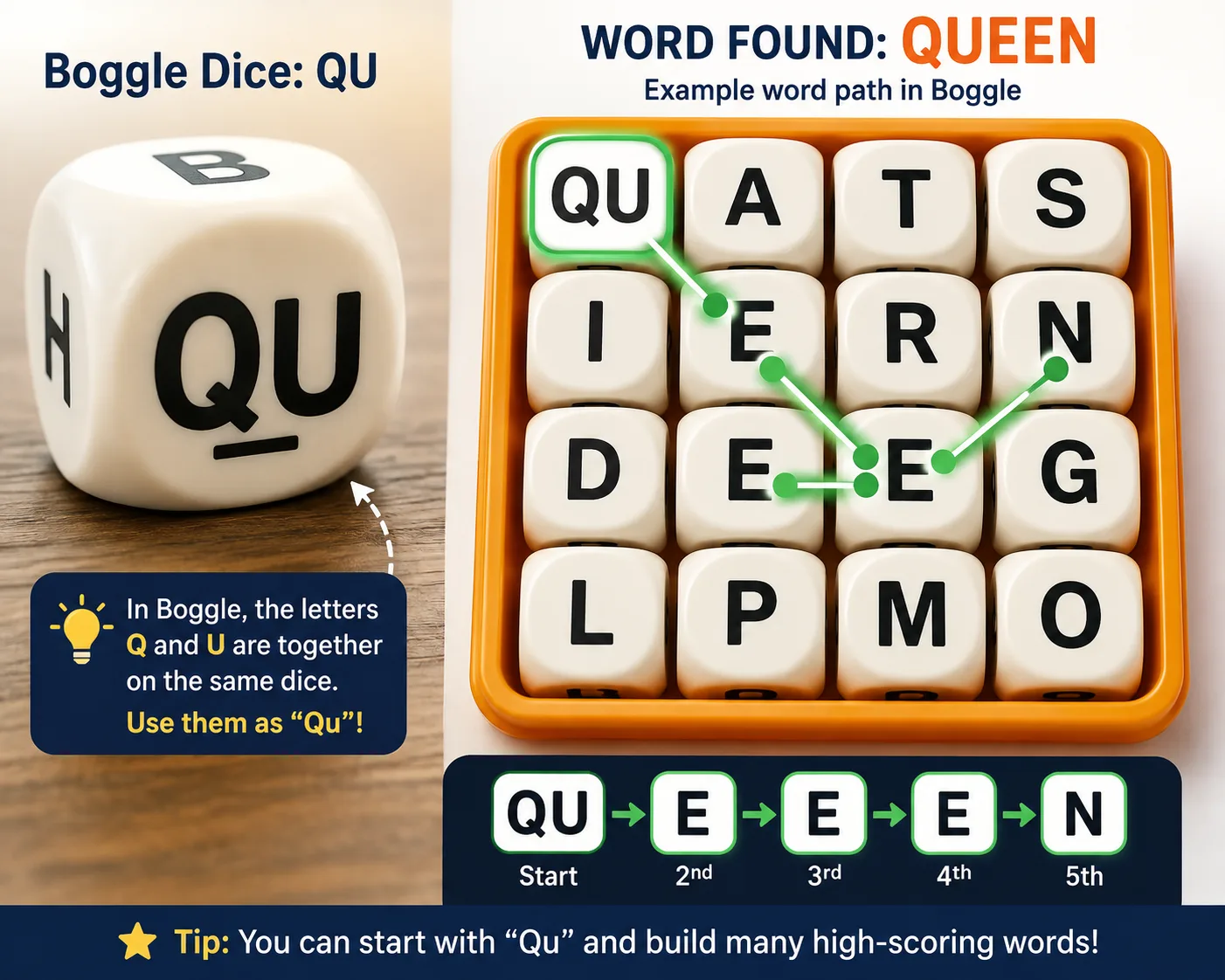
The Qu tile is special: it counts as two letters (Q + U). So a word like "QUIET" is 5 letters (worth 2 points) even though it uses only 4 dice. This makes Qu words especially valuable — learn more in our Qu tile guide.
Scoring is simple — the longer the word, the more points:
| Word Length | Points |
|---|---|
| 3–4 letters | 1 |
| 5 letters | 2 |
| 6 letters | 3 |
| 7 letters | 5 |
| 8+ letters | 11 |
One 8-letter word (11 points) is worth more than eleven 3-letter words. That's why the best players hunt for long words first, then sweep for short ones as the timer runs out. See our full scoring guide for worked examples.
Each difficulty uses a different set of letter dice, tuned for a different experience:
| Difficulty | Vowel Faces | Timer | Best For |
|---|---|---|---|
| Easy 🌱 | ~43% | 5 minutes | Beginners, casual play |
| Hard 🔥 | ~35% | 3 minutes | The classic Boggle experience |
| Extreme 💀 | ~22% | 2 minutes | Seasoned word hunters |
Extreme mode swaps common vowels for rare consonants (J, Q, X, Z) and tightens the timer to 2 minutes — a brutal test of pattern recognition. Master it with our Extreme mode tips.
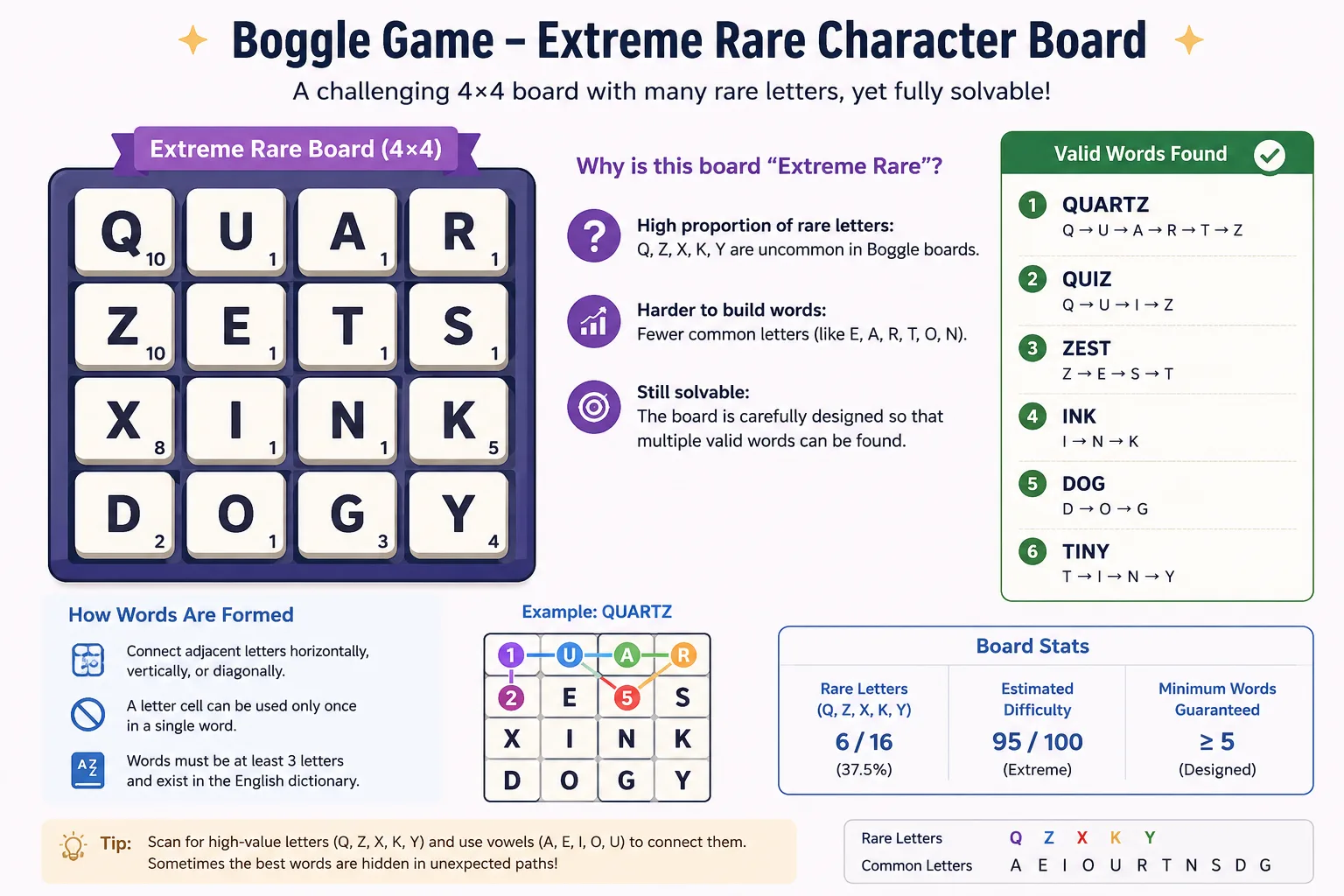
Choose your difficulty and play anytime. Race the timer, score points, and unlock achievements.
Play now →Everyone worldwide plays the same board each day. Compete on the live leaderboard and build your streak.
Today's puzzle →A fresh themed board every day. Find all the theme words for double points — timed Daily mode or relaxed Zen mode.
Play today's theme →Love Boggle Party on Netflix? Learn the rules, the unique-word scoring, and how it compares to classic Boggle.
Netflix Boggle guide →Seven unique game modes, one for each day — Theme Word, Longest Word, Letter Limit, Reverse Boggle, and more.
Explore weekly →Hunt for hidden words in grids from 5×5 to 15×15. Timed or relaxed — your choice.
Find words →Share a board seed and compete head-to-head with friends on the exact same grid.
Challenge a friend →Behind the simple 4×4 grid is a thoughtfully engineered game. Here's a peek at the design philosophy that makes every board fair, every word validated, and every game worth playing.
Each difficulty uses a dedicated set of letter dice, carefully balanced so words are formable but never too easy. The classic Hard set uses the original 16 Boggle dice, with roughly 35% of faces being vowels. Easy mode boosts vowels to about 43% for beginner-friendly boards. Extreme mode drops to about 22% vowels and loads up rare consonants like J, Q, X, and Z — a genuine challenge for expert players.
One clever detail: the letter Q is printed together with U on a single die face. In English, Q almost always appears before U, so pairing them guarantees you can actually spell words with your Q. It's a small design decision with a big payoff for gameplay.
The Daily Challenge isn't random — it's deterministic. Each day's board is generated from a date-based seed, which means everyone worldwide sees the exact same grid. No luck, no different dice, just a pure test of word-finding skill. Your score is then compared against players around the globe on the live leaderboard.
The weekly challenges follow the same philosophy — each day of the week uses a fixed theme (Theme Word, Longest Word, Letter Limit, and more) that rotates on a schedule, so there's always something fresh to try.
When you submit a word, it's checked in real time against a dictionary of 47,501 English words using a fast trie data structure. The word must also be traceable through adjacent letters on the board. This two-step check ensures fair, consistent validation across every game mode — no edge cases, no guesswork. Curious what a board contains? Try our free Boggle Solver.
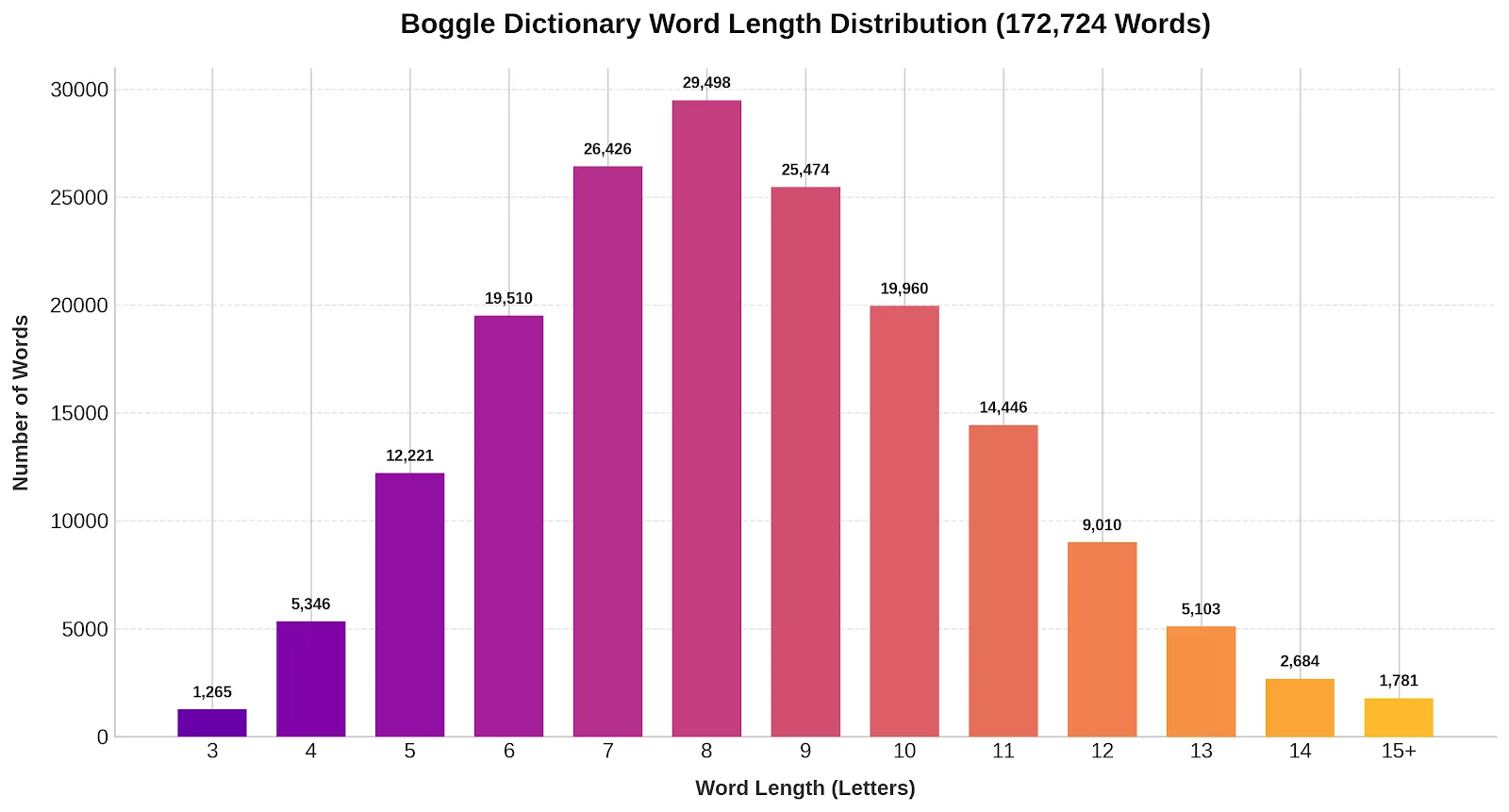
Every word you submit is validated against a comprehensive English dictionary of 47,501 words. That includes plurals, verb forms, and everyday vocabulary — giving you the same word-finding freedom as the classic board game. Here's how those words break down by length:
The dictionary also contains 221 words starting with "Qu" and 909 three-letter words — the backbone of any Boggle score. Explore the full breakdown in our Boggle word list guide.
Boggle was invented in 1972 by Allan Turoff and published by Parker Brothers. Its simple premise — shake 16 dice and find words in three minutes — made it an instant classic. Fifty years later, the core rules haven't changed, but online play has added exciting new twists.
Find words matching a weekly theme (Weather, Ocean, Space…) for quadruple points.
A massive 5×5 grid where only words of 5+ letters count.
A banned letter forces you to think around common vocabulary.
Find 8 hidden target words for 3×–6× score multipliers.
Only unique words count in head-to-head friend challenges.
An easy 3×3 board with 2-letter words allowed — perfect for kids.
Explore all seven in our weekly challenges, or dive into the full story in our Boggle history guide.
Boggle isn't just fun — it's genuine brain exercise. Regular play strengthens vocabulary recall, pattern recognition, processing speed, and working memory. Research links word-puzzle play to better cognitive performance across all ages. Learn more in our brain training guide.
Want more? Our Boggle tips & strategy guide covers advanced techniques.
| Game | Core Skill | Time | Best For |
|---|---|---|---|
| Boggle | Speed + pattern recognition | 3 min | Quick mental workout |
| Word Search | Visual scanning | Flexible | Relaxed focus |
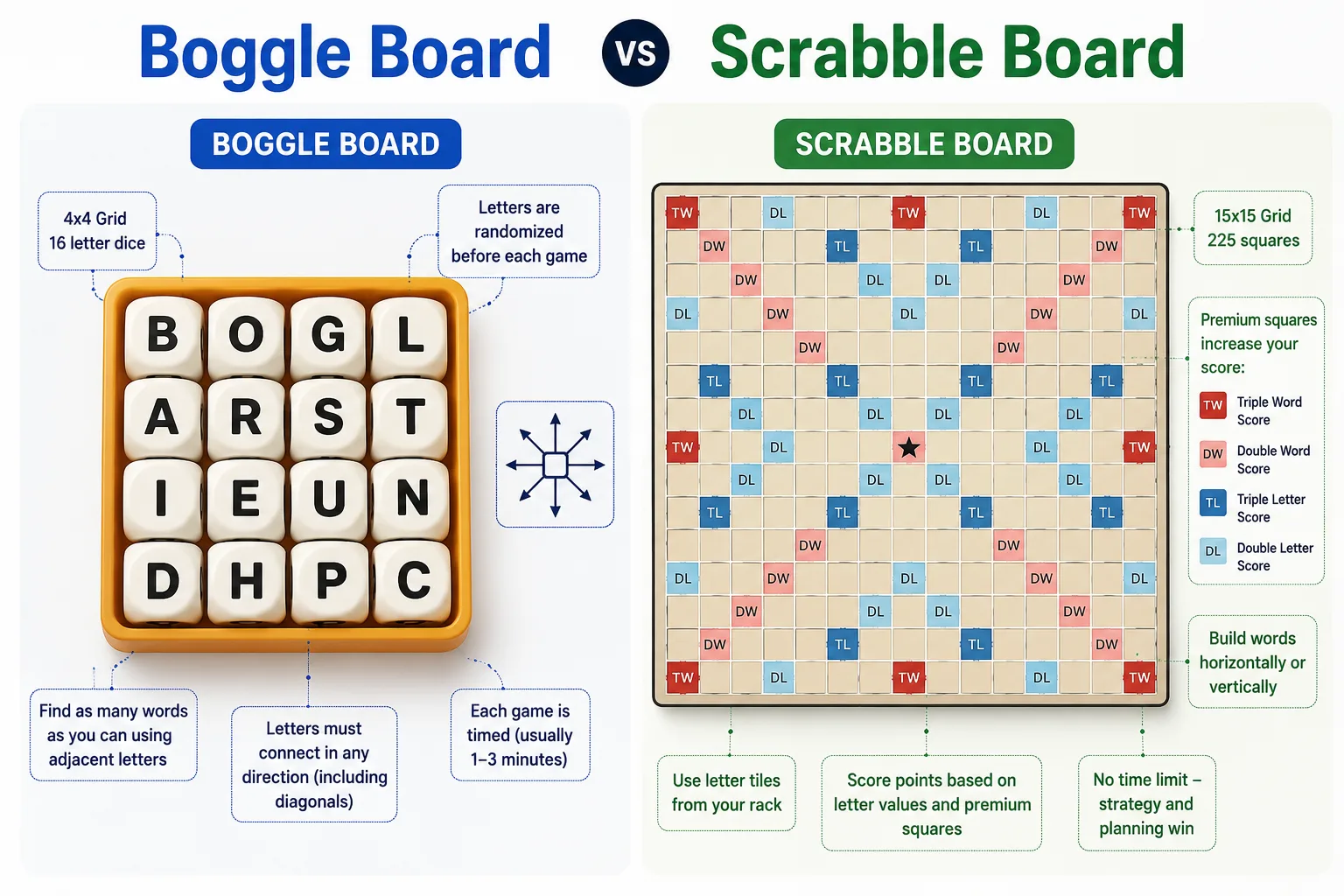
| Scrabble | Vocabulary + strategy | 20–40 min | Deep word building |
Prefer a deeper comparison? Read Boggle vs Word Search and Boggle vs Scrabble.
Not all online Boggle games are created equal. Here's what sets our implementation apart:
| Feature | Puzzle Boggle | Typical Online Boggle |
|---|---|---|
| Daily board | Deterministic seed, same for everyone | Random per player |
| Weekly modes | 7 rotating game modes | One standard game |
| Achievements | 7 unlockable badges | None |
| Leaderboard | Live global ranking | Local only |
| Dictionary | 47,501 words | Often limited |
| Word translate | Translate any word you find | Usually none |
| Sign-up | None — just play | Often requires an account |
Seven achievements reward your progress — from finding your first word to scoring 100+ in a single game or finding every possible word on a board. Unlock them as you play and track your progress right on the game page.
Our design principles: free for everyone, no account required, accurate word validation, genuine brain training, and a word-translate tool for players worldwide. We're always improving — see what's new in our update log.